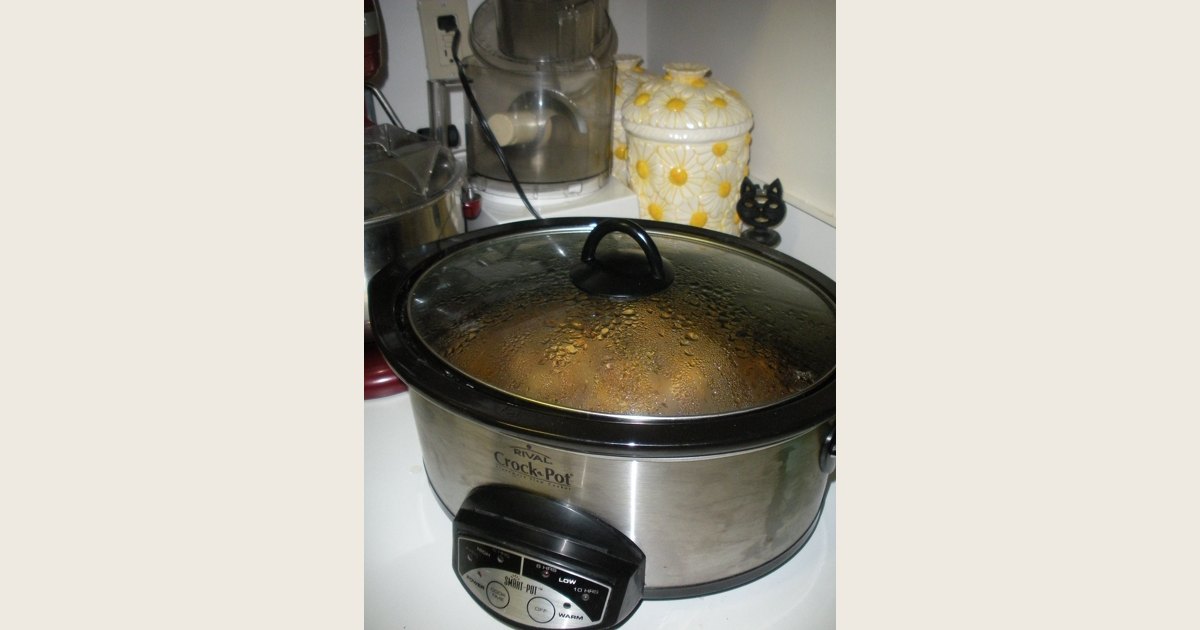
To use a slow cooker, start with a recipe written for the appliance. Prep ingredients, put long-cooking vegetables low in the crock, add the stated liquid, cover, and cook on the recipe’s Low or High setting. Keep the lid on, add delicate ingredients near the end, and use a food thermometer when a safe internal temperature applies.
Key Takeaways
- Use a slow-cooker recipe for your first meals. Low and High are schedule choices, not a universal time-conversion formula.
- Keep the lid on, use the recipe’s liquid amount, and add dairy, seafood, fresh herbs, and other delicate foods near the end.
- Safely thaw ingredients, refrigerate leftovers promptly, and reheat them to 165°F.
- Canned beans are ready to use. Raw dried red kidney beans need a separate boil before they go in the slow cooker.
Start with the parts and a forgiving recipe
A typical slow cooker has a heated base, a removable crock, and a lid. Wash the removable pieces before first use, dry the outside of the crock, and put the appliance on a stable, heat-safe counter. Its capacity, controls, insert-care instructions, and automatic settings vary by model, so check the manual before cooking.
For a first meal, choose soup, chili, a pot roast, or stew. These dishes suit long, moist cooking. A recipe written for a slow cooker accounts for its covered environment, making it a better starting point than trying to convert an unfamiliar oven recipe.
Use this basic slow-cooker sequence
Prep evenly, layer long-cooking foods low in the crock, add only the stated liquid, cover, and check the finished food rather than the clock alone.
- Cut evenly. Cut dense vegetables to a similar size. Trim and cut meat as directed.
- Layer dense foods low. Put root vegetables and onions closest to the heated crock; add meat and softer vegetables above unless the recipe says otherwise.
- Add the stated liquid, seasoning, and sauce. The covered crock retains moisture, so it does not behave like an uncovered pot.
- Cover and select Low or High. Use the recipe’s time as a cue to check the food.
- Lift the lid only when needed. Open for a planned late addition or to check the endpoint.
- Add short-cooking ingredients late. Stir in cream, tender greens, cooked pasta, seafood, fresh herbs, or thickener at the specified point. Use a thermometer when an internal temperature applies.
For meat, poultry, fish, and leftovers, the endpoint temperature establishes safety (FDA Safe Food Handling).
Low, High, and Warm: choose by the recipe and your schedule
Choose Low for a longer window and High when the recipe offers a shorter one. Do not assume a fixed conversion: the cooker, fullness, starting temperature, ingredient size, and food all influence timing. If a recipe gives both options, use its listed times and begin checking at the earlier end of the range.
Warm is for holding food that has already cooked, not for cooking a chilled meal. Features vary. Hamilton Beach’s model 33762, for example, lets the user select Warm, Low, or High and automatically changes to Warm after its timed cycle, but that behavior does not apply to every cooker (Hamilton Beach 6 Quart Programmable Slow Cooker).
Match the batch to your cooker
Use the capacity range in your manual and a recipe that names a cooker size when possible. Do not pack a large batch into a small crock or make a tiny batch in a much larger cooker without checking the manufacturer’s directions.
Hamilton Beach’s current listings span 3 to 10 quarts, but capacity is only one specification: controls, inserts, and cleanup features vary by model (Hamilton Beach Slow Cookers). A recipe-sized cooker is more useful than buying the largest one by default.
Build flavor and protect delicate ingredients
Browning meat first is optional. It adds color and roasted flavor but does not replace cooking food to a safe endpoint. If you brown, scrape the browned bits into the cooking liquid.
Dense vegetables go low; softer vegetables go higher. Add dairy, seafood, fresh herbs, cooked pasta, and other fragile ingredients near the end. Dairy can separate with prolonged heat, fresh herbs can lose their fresh flavor, and seafood can become firm quickly. Use acidic ingredients at the point a tested recipe specifies because they can affect the texture of beans and vegetables.
Adapt other recipes cautiously
A slow cooker suits braises, soups, and stews, but it does not brown or crisp food well, reduce sauce quickly, or respond like a stovetop burner. When adapting an oven or stovetop recipe, compare it with a slow-cooker version first. Plan for less evaporation, cook crispy components separately, and move dairy and quick-cooking ingredients to the end.
Food safety before, during, and after cooking
Start with safely thawed ingredients. The FDA says to thaw food in the refrigerator, cold water, or a microwave, not on the counter. Food thawed in cold water or the microwave should be cooked immediately. Keep refrigerated perishable food at 40°F or below until prep time (FDA Safe Food Handling). Do not put frozen meat or poultry straight into a slow cooker: thaw it safely first.
Treat raw dried red kidney beans differently from canned beans
Canned beans and beans that have already been fully boiled can go into a slow-cooker recipe as directed. Do not use the slow cooker alone to prepare raw dried red kidney beans. The FDA identifies phytohaemagglutinin, a lectin found at high levels in red kidney beans, as a safety concern. For dry red kidney beans, soak them for at least five hours, discard the soaking water, add fresh water, and boil them for at least 30 minutes before using them in the recipe. The FDA warns that cooking at 80°C (176°F) may increase toxicity and that slow cookers may not get hot enough to destroy the toxin (FDA Bad Bug Book).
Check the safe endpoint with a thermometer
Color and texture are not reliable safety tests for meat, poultry, seafood, or egg products. The FDA’s safe minimum temperatures are useful whether food is cooked in a slow cooker, oven, or skillet:
| Food | Safe minimum internal temperature |
|---|---|
| Beef, pork, veal, and lamb steaks, chops, and roasts | 145°F, then rest for 3 minutes |
| Ground meat | 160°F |
| Poultry, including ground poultry and stuffing | 165°F |
| Fin fish | 145°F, or flesh is opaque and separates easily with a fork |
| Leftovers and casseroles | 165°F |
Source: FDA Safe Food Handling.
After the meal, refrigerate cooked food within two hours, or within one hour above 90°F. Divide large amounts into shallow containers and keep the refrigerator at 40°F or below (FDA Safe Food Handling).
Do not rely on a slow cooker to reheat refrigerated leftovers. Reheat them by a suitable rapid method, such as the stovetop, oven, or microwave, to 165°F; bring sauces, soups, and gravy to a boil. If the manual permits, transfer already-hot food to the cooker only for holding on Warm (FDA Safe Food Handling; Hamilton Beach 6 Quart Programmable Slow Cooker).
Fix common slow-cooker problems
The vegetables are still firm
Keep the lid on and continue cooking. Next time, cut dense vegetables smaller and more evenly, place them lower in the crock, and choose a recipe that suits your cooker size.
The sauce is too thin
For the next batch, start with a slow-cooker recipe or reduce liquid only when it allows it. For the current meal, thicken at the end, puree some cooked beans or vegetables, or simmer the sauce separately.
The meat is dry or tough
Lean meat can dry out, while braising cuts need enough covered cooking to become tender. Check that the cut and setting match the recipe. Tough meat may need more cooking; dry but tender meat is best served with its cooking liquid.
Dairy looks grainy or split
Add cream, milk, cheese, and similar ingredients late. If the texture is off, serve it as is or blend a small portion if that fits the recipe.
Decide whether to own one and what to look for
You may not need a slow cooker. A Dutch oven in a low oven can make many of the same dishes, while a covered stovetop pot offers more browning and sauce reduction. If you mainly cook quick meals, want crisp textures, have limited storage, or already prefer a heavy pot for braises, a slow cooker may add little.
If you do want one, choose by the meals and space you have:
- Capacity: Match it to your usual recipe yield and portions. Larger is not automatically better for a small batch.
- Controls: Manual Low, High, and Warm controls are simple. With a programmable model, check whether it switches to Warm automatically.
- Insert and cleanup: Check removable-crock material, weight, dishwasher-safe components, and whether you can comfortably lift and store it.
- Footprint and parts: Measure the storage space, including the lid. If replacement parts matter to you, check their availability before buying.
Features are model-specific. Current manufacturer listings include manual and programmable controls, automatic-Warm models, stoneware or nonstick inserts, dishwasher-safe parts on some models, and storage or transport features (Hamilton Beach Slow Cookers).
A slow cooker earns its space when you regularly want long, covered meals with little active attention. Use a recipe built for the appliance and verify food safety with the appropriate endpoint.
Featured image: “Slow-cooker venison neck roast” by Jason Riedy, licensed under CC BY 2.0. Resized and padded. Illustrative stock image; no product testing is implied.