A Japanese rice cooker is a good choice when rice is a regular part of your meals and you want more control than a basic one-button cooker provides. The most useful features are usually the least flashy: the right capacity for your household, a rice-specific measuring system, a dependable keep-warm setting, and parts you’ll actually wash after dinner.
The label is not a guarantee that every model works the same way. Japanese brands sell basic Micom (microcomputer-controlled) cookers as well as induction-heating models; some higher-end cookers from other Asian brands add pressure cooking. Start with the rice you make most, how much you serve, and how long you expect cooked rice to sit before choosing a technology tier. If your household already uses another set-it-and-forget-it appliance, the same habit of matching a machine to your routine applies in our guide to using a slow cooker.
Key Takeaways
- Buy capacity for your usual batch, not the largest batch you make once a year; a “cup” on a rice cooker may mean the included rice measure, not a U.S. measuring cup.
- Micom models suit many everyday households. Induction heating and pressure cooking add control and can cost more, so choose them for a specific need rather than the label alone.
- Confirm the electrical rating on the exact U.S. model. A U.S.-market cooker should list 120V AC and 60Hz; do not assume an imported Japanese unit is compatible.
- A removable inner lid, accessible steam area, and clear cleaning instructions matter as much as cooking menus.
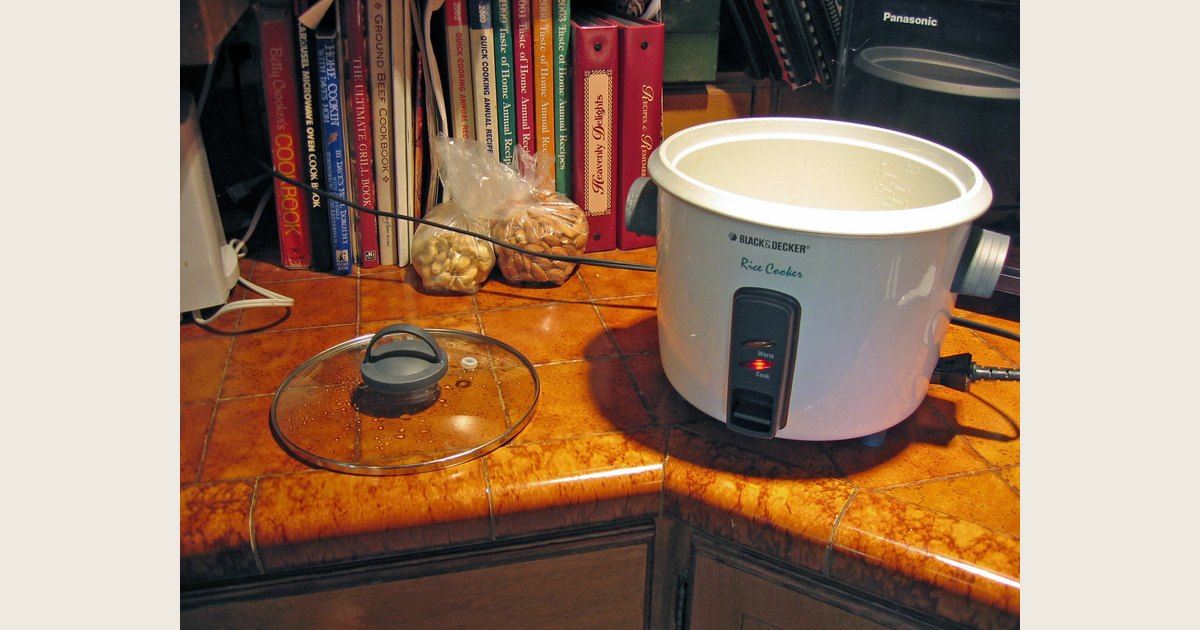
Cover image credit: Rice Cooker by alex.shultz; CC BY 2.0. Resized and padded. Illustrative stock photo; no product testing is implied.
What makes a Japanese rice cooker different?
A Japanese rice cooker is best understood as a rice-focused countertop appliance with programmed heat control, rather than as one uniform category of machine. Many models use a microcomputer—often called Micom—to manage the cooking cycle. Others use induction heating (IH), which generates heat in the inner pot rather than relying only on a heated plate underneath it.
That distinction can matter, but it is not a shortcut to a perfect purchase. The cooking program, inner pot, capacity, and the model’s intended market all shape the result. Tiger, for example, describes its rice-cooker work in terms of fine temperature control and offers both Micom and IH models in its U.S. product list (Tiger Corporation, accessed September 22, 2026).
Look for programs that match the rice you actually make, plus a delay timer, keep-warm setting, nonstick or coated inner pot, and removable lid or steam parts. “Japanese rice cooker” does not necessarily mean it is made in Japan or right for every budget; compare the specifications of the exact model in front of you.
Choose capacity by the amount of uncooked rice you really make
For most shoppers, capacity is the first decision. Rice-cooker capacity is normally stated in uncooked rice, and the included cup is often a proprietary rice measure. Use that scoop and the fill lines inside the pot when the manual tells you to; substituting a U.S. cup can throw off the rice-to-water ratio.
A practical way to choose is to think about ordinary meals, not holiday leftovers:
| Your typical use | A sensible starting point | What to check |
|---|---|---|
| One or two people | Small cooker | Whether it has a useful minimum batch size |
| Three to five people or frequent leftovers | Mid-size cooker | White-rice capacity and inner-pot fill lines |
| Larger households, meal prep, or entertaining | Large cooker | Counter space, storage weight, and minimum amount |
For example, a two-person household that usually makes dinner plus lunch leftovers may get more value from a small cooker with a workable minimum line than from a much larger model. Porridge and mixed dishes can also use different maximum lines than plain white rice.
CUCKOO lists its CRP-LHTR1009F as holding 10 cups uncooked and 20 cups cooked (CUCKOO America, accessed September 22, 2026). That helps interpret a “10-cup” label—not every brand’s cup or yield will match it.
Micom, induction heating, and pressure: which level fits your kitchen?
Micom is the sensible default for many homes. A microcomputer-controlled cooker follows a programmed cooking cycle. If you mainly make white rice, occasionally cook brown rice or porridge, and want straightforward operation, a Micom model can be enough.
Induction heating is worth considering when precise heat management is your priority. IH models heat the inner pot differently from a conventional bottom heating plate. That is a design difference, not a promise that every IH cooker will outperform every Micom cooker. It also tends to move a model into a higher price and feature tier.
Pressure cooking adds another choice rather than a universal upgrade. Some cookers let you select pressure or non-pressure cooking to target different textures. CUCKOO’s cited U.S. model, for example, describes high-pressure cooking for stickier rice and non-pressure cooking for fluffier rice, alongside induction heating (CUCKOO America, accessed September 22, 2026). Pressure models may also have more seals, valves, and instructions to maintain.
| If this sounds like you | Start by looking at |
|---|---|
| Plain white rice most weeks | A compact or mid-size Micom cooker |
| Several rice and grain types | A Micom or IH model with labeled grain programs |
| Texture is a high priority | An IH model; compare pot, menus, and care |
| Both sticky and lighter textures | A pressure/non-pressure model, after checking care instructions |
Do not pay for menus you will not use.
Look closely at the inner pot and cleanup routine
Look for legible fill lines and care instructions you can follow. “Ceramic,” “stainless,” and “nonstick” do not tell the full story: construction and coating vary by model. If you prefer a maintenance routine written out step by step, our guide to descaling an espresso machine offers a useful example of how appliance cleaning instructions can differ by manufacturer.
Tiger describes ceramic inner-pot and coating technology in some lines as supporting heat retention and controlled cooking (Tiger Corporation, accessed September 22, 2026). That does not make one material right for everyone. Before buying, check for a removable inner lid, accessible steam parts, clear base-cleaning instructions, and replacement parts. CUCKOO specifies a detachable inner lid and coated stainless pot for its cited model (CUCKOO America, accessed September 22, 2026).
Keep-warm is useful, but it has limits
A keep-warm setting is for holding a finished meal, not indefinite storage. Rice can dry or firm up as it sits, so follow the manual’s timing guidance. For leftovers, FDA guidance says to refrigerate or freeze perishables promptly and not leave foods that need refrigeration at room temperature for more than two hours—one hour above 90°F; this guidance also applies to leftovers (FDA, accessed September 22, 2026).
Compare regular versus extended warming, the lid’s condensation handling, and the documented method for reheating chilled rice. CUCKOO says its cited twin-pressure IH model detects grain type and internal temperature and includes automatic keep-warm (CUCKOO America, accessed September 22, 2026). That may help with dinner timing, but it does not replace safe leftover storage.
Confirm voltage before you buy
For a U.S. kitchen, buy a cooker intended for U.S. electrical service unless the manufacturer specifically documents otherwise. Check the product label or specifications for 120V AC, 60Hz, and use the appliance as directed. Do not assume a model sold for Japan will be appropriate just because the plug appears similar.
The CUCKOO example lists 120V AC, 60Hz and 1,090W for its U.S.-market model (CUCKOO America, accessed September 22, 2026). Your exact model may differ. Voltage, wattage, warranty coverage, and replacement parts should all be verified before checkout—especially on marketplace listings that combine international versions on one page.
A five-minute buying checklist
Start with the product manual or support page, not the marketing headline.
- Match capacity to ordinary batches and the stated minimum and maximum lines.
- Match named programs to the grains you cook.
- Choose Micom unless IH or pressure solves a real preference.
- Confirm 120V AC, 60Hz and the exact model number.
- Review cleaning instructions and replacement-part availability.
- Measure counter and cabinet clearance for large cookers.
For the first few batches, use the included cup and pot markings, then note the setting and water level you prefer.
If you already own a rice cooker and want another use for it, try our guide to cooking quinoa in a rice cooker. It explains how to adapt a rice cooker to a different grain without assuming every model has the same settings.
Common Japanese rice cooker problems
Why is the rice too wet or too dry?
The usual cause is an inconsistent rice-to-water measurement, not a broken cooker. Use the supplied scoop, rinse and drain rice consistently, and follow the pot’s fill lines or manual for the selected rice type. If you change varieties, begin with the manufacturer’s guidance again rather than reusing a ratio from a different grain.
Why does the cooker smell stale after a few uses?
Clean the removable inner lid, steam vent or cap, condensation collector, and pot after they cool. Let the parts dry fully before reassembly.
Is induction heating always better than Micom?
No. IH is a different heating approach. Micom can be the better buy when its capacity, programs, cleanup, and price fit your routine.
Can I use a Japanese-market rice cooker in the United States?
Only if its rating label and manufacturer instructions explicitly support that use. Imported units can have different voltage, warranty, and service options.
The best choice is the cooker you can use and clean consistently
Choose a Japanese rice cooker for its fit with your meals, not its longest feature list. A correctly sized Micom cooker with a clear rice guide and washable lid parts will be more helpful than a complicated machine you avoid using. Move up to IH or pressure only when their texture options and controls match the rice you enjoy.
Before ordering, confirm the exact model number, U.S. electrical rating, capacity definition, and care instructions. Then give the cooker a few batches to learn your preferred setting. Consistency—not a prestige feature—is what turns a rice cooker into a genuinely useful kitchen appliance.